What is a model solo and why should I care?? That’s what my non-musician wife asked me after I passionately spoke to her about it for 30 minutes straight last night… lol. Just kidding, she stopped me after 40 seconds. To put it simply, it’s a solo that you compose and write down on a given tune. And if you are serious about developing your own jazz language, it’s probably the single best use of your practice time I can think of.
Goals
The goals are multiple :
- To me, the main goal is to experiment with new concepts and see in what context they fit. You create a bit of vocabulary from these concepts and build the muscle memory to get these ideas out of you when improvising.
- It can also solidify existing skills and force you to examine how they interact with different musical elements like chord progression, solo momentum, space… etc.
- It is also very good for building a sense of structure in your soloing, so that the solo climaxes at the right time.
These are just 3 basic goals, but the list could be as long as there are musical skills involved in improvising.
My Approach
So you might say: “Well, how am I practicing improvisation if I’m not improvising?” That’s where most people miss the point about model solos and improvisation. The line between both is much grayer than you might think. Good written solos are often based on improvisations, and improvisers have been learning written solos for ages before feeling confident in their own improvising. I would add that written solos created only out of music theory are more often than not bad and boring. We could argue the same about improvisers who never learned a written solo.
Let me explain my approach to model solos. First, I practice improvising on a tune for a while and actively think about what sounds good to my taste, how I would like to structure my solo, and what tools I would like to use or implement. Then I start the song from the beginning, record my improvisation bit by bit, and think about it.
“Do I like how I started?”, “Was it too busy for the beginning?”, “Should I start with a melodic variation of the head?”… etc.
Once I like the first few bars, I move on to the next few. I start a few bars before, listen to my solo and continue from where I left off. Sometimes I can lock a complete form, sometimes just a few bars, but that doesn’t matter. What’s important is the active thinking, listening and decision making you are doing.
The goal is to write something good, well paced and interesting. The tools I’m using are the ones I want my improvised solo to use, or new tools I want to implement.
Rhythm & Blues Model Solo
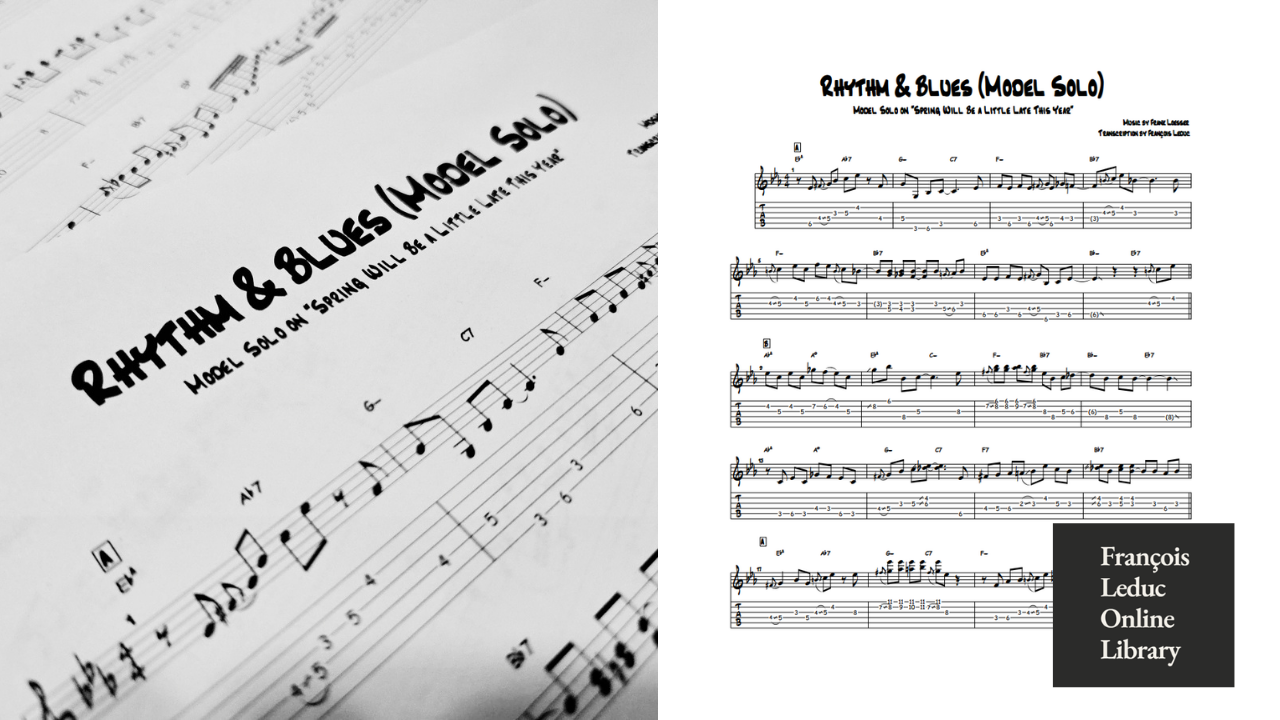
I don’t usually write down and record full model solos. Most of the time, I do the process in my head and practice from memory. But last year I was practicing a bunch of concepts and I just kept going, and ended up with a full 4-minute solo. I’ll break down a few segments with some of my thoughts and approach.
First off, my initial idea was to make a basic pentatonic solo that suggested a chord progression. I realized that aiming for basic chord tones like the root, 5th and 3rd while playing pentatonic was really efficient. It gave pentatonic ideas the storytelling effect of a bebop solo: a sense of melodic direction, instead of a blues layer stacked over a tune, if that makes sense.
So my first example is the first few bars :
Ex.1:
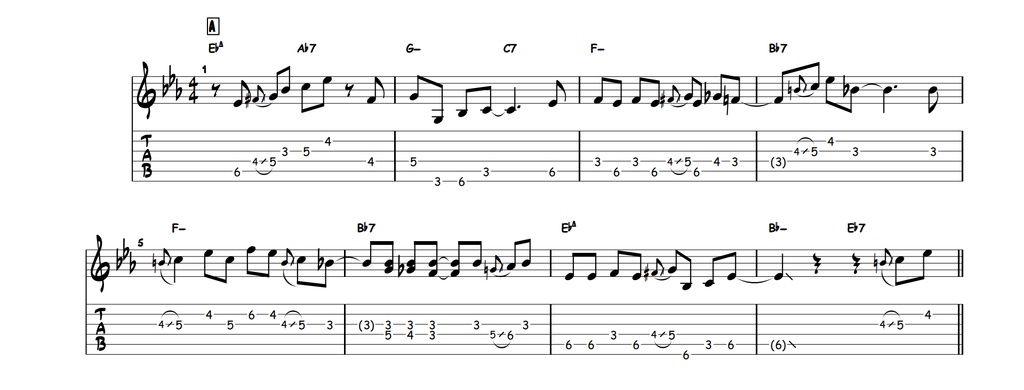
To kick off the solo, I limited myself to Eb pentatonic with a few blue notes and aimed mostly for roots. I think it gave the solo a very ‘singing’ quality. The result was so convincing that I built the whole 1st form on that idea, with more and more blue notes and more sophisticated chord tone targeting. It made the form sound almost like a head.
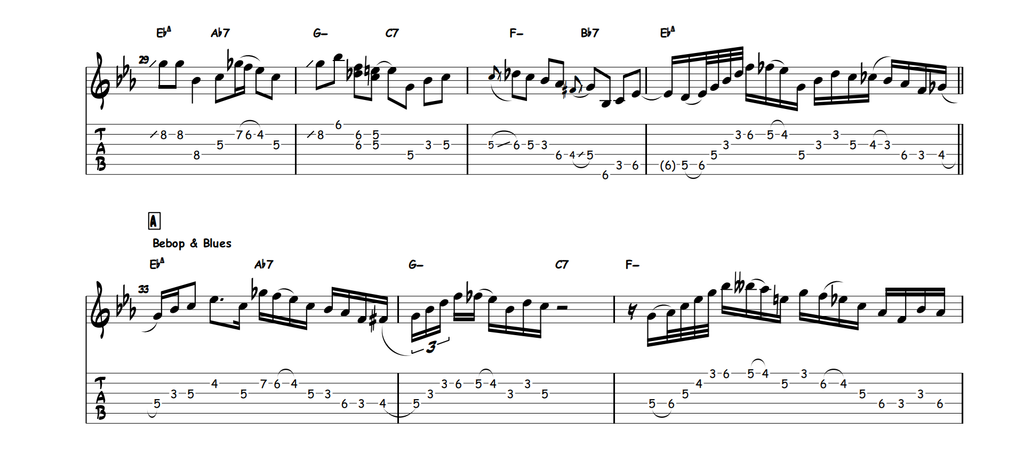
Let’s jump to example 2. At the turn of the form, I wanted to add a ‘kick off’ line like we often hear in bebop, then switch to a full bebop-influenced solo with some added blues color. Bar 32 is a very idiomatic Eb bebop line. Then I follow with some of my favorite bebop lines in Eb, almost on autopilot. Take a closer look at the Ab7 in bar 33: I’m adding the Gb blue note to outline the blues flavor of the Ab7. Note that I’m avoiding straight Ab7 lines. I’m thinking of Eb for the whole 2 bars and adding a bit of blues sound to it. To me, bars 33 and 34 are a long Eb with added movement in the harmony.
Ex.2
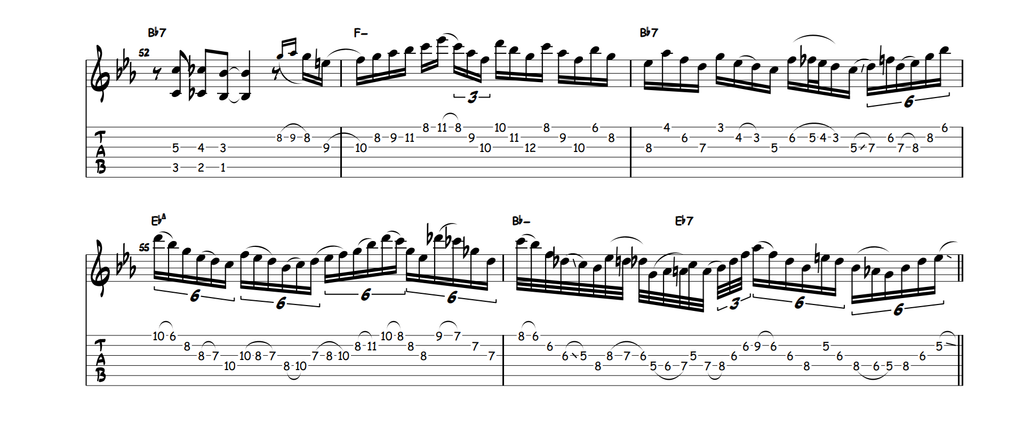
Example 3 is where I had the most fun. I’m coming from a bluesy octave melody (not in the example), and to contrast the blues sound, my idea was to embark on a lyrical diatonic triad succession that would climax into a full-blown double-time bebop flurry. Quite ambitious! It took me a lot of trial and error, and just as many takes, to land it correctly. Then I had to transcribe it from the recording because I had no clue what I even played.
And, believe it or not, I made so many takes that it crystallized in my memory. These lines are now part of my vocabulary, and they show up uninvited from time to time.
By the way, don’t try to follow the rhythm notation on the double-time part: I just played it as fast as I could. I think it enhances the ‘flurry’ effect, and since these are all standard bebop 4-note groups, it still makes sense to the listener’s ear.
Ex.3
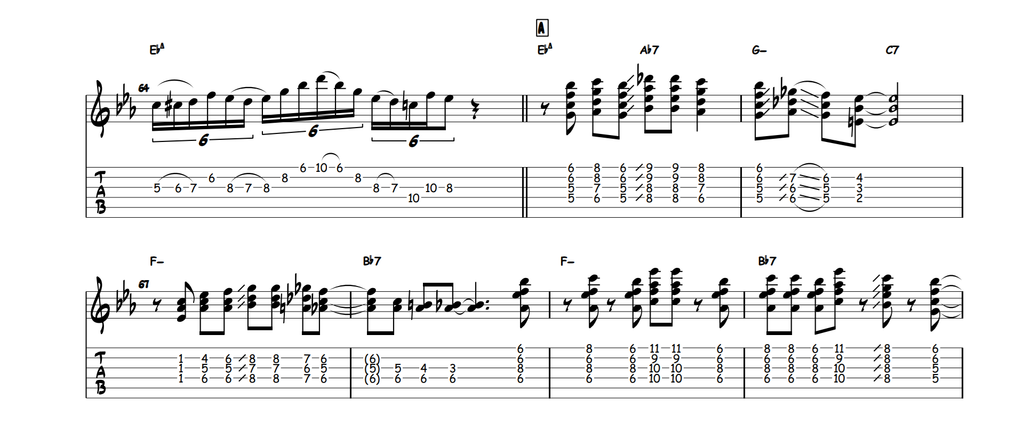
Last but not least. For the last form, I went with some key-centered blues ideas I had been juggling with since the beginning of the solo, but applied to a chord melody solo.
I thought the idea was worth working on because the usual approach to chord melody is to manage chord quality according to the accompaniment and add the desired melody note on top. With my key-centered blues approach, I’m treating the whole chord progression as Is and IIs.
In bars 65 and 66, I’m only thinking of Eb blues and aiming for the C7(#9) voicing, which also has a strong blues flavor. In the 2nd line (bars 67 to 70), I’m only thinking of Fm7. I find it’s the best and easiest way to navigate complex chord progressions in chord solos. Instead of only playing notes that are already there, you are adding ingredients to the recipe. As simplistic as it may seem, it actually adds sophistication to the harmony. That’s something I really wanted to crystallize in my vocabulary.
Ex.4
This model solo is based on “Spring Will Be A Little Late This Year”. What song would you pick for a model solo?
See you next time!
Complete transcription and backing track available here:
Rhythm & Blues Study – Model Solo on ‘Spring Will Be A Little Late This Year’