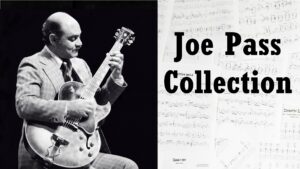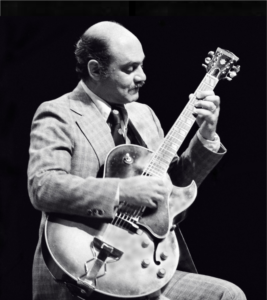
What belongs there is why this guitarist is worth a player’s time: where he sits among the others, what he does that nobody else does, who should study him and who shouldn’t bother yet. First person, opinion allowed. A hundred words is plenty.
The questions to answer when you’re staring at a blank box: If a student asked me why they should learn Joe Pass, what would I say? What did he solve that others didn’t? Who does he not suit?
Notable Recordings :
- Sounds of Synanon (1962)
- Catch Me (1963)
- For Django (1964)
- Intercontinental (1970)
- Virtuoso (1973)
- I Remember Charlie Parker (1979)
- Eximious (1982)
- Blues for Fred (1985)
Stylistic Elements
Bebop Language :
While Joe Pass is often associated with his Solo Guitar mastery from his “Virtuoso” era, early in his career Joe’s main weapon was his Bebop language fluency. Joe’s Bebop language is build on a perfect understanding of early Bebop syntax which is rare to see on guitar. His solos features a perfect blend of various other authentic bebop devices like; blues licks, enclosures, extended arpeggios & double stops. His neck mastery is characterized by a very wide horizontal ease. He is often using this skill to extend ideas beyond traditional positional playing.
The next example demonstrate some of these devices like extended arpeggios, double stops and enclosures. Pay a special attention to his wide horizontal approach to the fretboard.
Ex. from: Deep Purple – Catch Me (1963)
In the next one, pay attention to where he’s using minor blues Pentatonic. Basically he’s using it at the end of a form to outline a ‘turn’ and also at the beginning of the next form to give that Blues head feel. Both on root chord. These are the most typical Blues Pentatonic placement from early bebop, similar to how Charlie Parker would use it.
Ex. from: Let It Snow! Let It Snow! – Six-String Santa (1992)
Block Chord Heads & Soloing:
Another very important Joe Pass devices is his uses of Block Chords in heads and while soloing (What is a Block Chord?). Although he’s using this device quite a lot, he will generally avoid it while soloing with a piano or a 2nd guitarist. You will mostly hear his Block Chord soloing in trio settings when there’s no one to do ‘comping’.
The next example demonstrate some of these devices like extended arpeggios, double stops and enclosures. Pay a special attention to his wide horizontal approach to the fretboard.
Ex. from: Deep Purple – Catch Me (1963)
In the next one, pay attention to where he’s using minor blues Pentatonic. Basically he’s using it at the end of a form to outline a ‘turn’ and also at the beginning of the next form to give that Blues head feel. Both on root chord. These are the most typical Blues Pentatonic placement from early bebop, similar to how Charlie Parker would use it.
Ex. from: Let It Snow! Let It Snow! – Six-String Santa (1992)
Bebop Language :
While Joe Pass is often associated with his Solo Guitar mastery from his “Virtuoso” era, early in his career Joe’s main weapon was his Bebop language fluency. Joe’s Bebop language is build on a perfect understanding of early Bebop syntax which is rare to see on guitar. His solos features a perfect blend of various other authentic bebop devices like; blues licks, enclosures, extended arpeggios & double stops. His neck mastery is characterized by a very wide horizontal ease. He is often using this skill to extend ideas beyond traditional positional playing.
The next example demonstrate some of these devices like extended arpeggios, double stops and enclosures. Pay a special attention to his wide horizontal approach to the fretboard.
Ex. from: Deep Purple – Catch Me (1963)
In the next one, pay attention to where he’s using minor blues Pentatonic. Basically he’s using it at the end of a form to outline a ‘turn’ and also at the beginning of the next form to give that Blues head feel. Both on root chord. These are the most typical Blues Pentatonic placement from early bebop, similar to how Charlie Parker would use it.
Ex. from: Let It Snow! Let It Snow! – Six-String Santa (1992)